
 EN
 AR
 BG
 HR
 DA
 NL
 FI
 FR
 DE
 EL
 HI
 IT
 JA
 KO
 NO
 PL
 PT
 RO
 RU
 ES
 SV
 TL
 IW
 ID
 LV
 SK
 SL
 VI
 ET
 HU
 TH
 TR
 AF
 LB

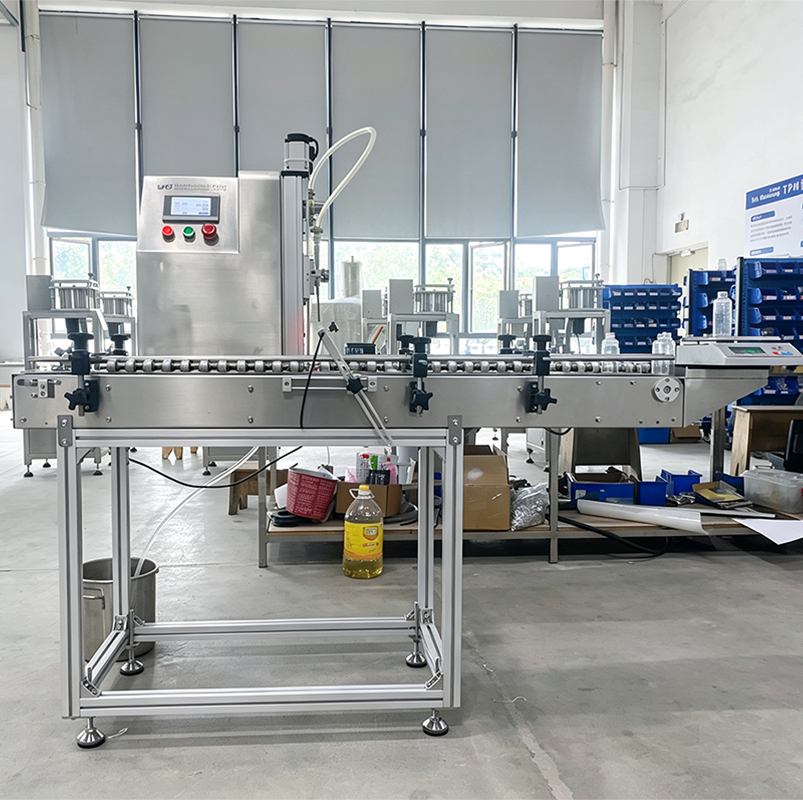
When a fragrance business introduces new scents or produces several bottle formats in separate batches, the filling station needs to fit that workflow. The YD-GZ-1 desktop liquid filling machine from Dongguan Yide Machinery Co., Ltd. is a semi-automatic, single-nozzle unit designed for small-scale and multi-batch liquid filling. For production managers considering an in-house bottling station, it offers a workbench-format option to evaluate with their own bottles and formulations before moving to a larger integrated line.
Why consider a desktop filler for small batches?
Small-batch planning is about more than the fastest dispensing cycle. A practical equipment decision also considers bottle preparation, product changeovers, access for cleaning and the work that happens after filling. The right starting point is the complete batch, not the nozzle alone.
Yide positions the YD-GZ-1 semi-automatic liquid filling machine for small factories, laboratories and start-up production lines. Its desktop format allows the filling operation to be planned as a dedicated workstation. Assess that workstation against the products you actually make rather than assuming a larger line is always necessary.
What the YD-GZ-1 brings to the filling station
A single-nozzle configuration
The YD-GZ-1 has one filling nozzle. This provides a defined dispensing point around which to organize bottle positioning and sample checks. The supplied images show a control panel, a vertical nozzle assembly, a conveyor and guide rails with adjustment knobs.
Use those visible features as a starting point for a bottle trial. Ask Yide to demonstrate how the intended bottle reaches the filling position, how the nozzle is set and which loading or handling steps require an operator. The conveyor does not, by itself, establish fully automatic bottle feeding.
A specified range for different batch requirements
The supplied specification lists a filling range of 10–1000 g. Select trial points that correspond to your actual products and confirm how the machine is set and checked at each target. If your product specification uses milliliters, agree on the material-specific conversion or calibration rather than treating grams and milliliters as interchangeable.
A workbench-oriented layout
The listed machine dimensions are 171 × 61 × 76 cm, with a listed weight of 50 kg. Use these figures to begin the layout discussion, then confirm the support arrangement, load requirements and access space with Yide. The supplied workshop photos also show the machine on a support frame; confirm whether that frame is included in the offered configuration.
YD-GZ-1 technical specifications
|
Parameter |
Supplied specification |
|
Model |
YD-GZ-1 |
|
Equipment type |
Desktop semi-automatic liquid filling machine |
|
Power supply |
220 V, 50 Hz |
|
Power |
1.3 kW |
|
Filling nozzle |
Single nozzle |
|
Filling pump size |
6 L, as stated in the specification |
|
Filling range |
10–1000 g |
|
Filling speed |
10–60 pieces/min |
|
Filling accuracy |
Listed as “1 gram error” |
|
Filling tank capacity |
60 L |
|
Heating temperature |
Listed as 0–120 °C |
|
Machine dimensions |
171 × 61 × 76 cm |
|
Weight |
50 kg |
These are supplied equipment specifications, not results from a trial with your product. Confirm the definition of filling error and the conditions behind the speed range. The pump-size entry does not state a flow rate, and the listed tank capacity should be checked against the actual supply arrangement and included components.
Plan the workstation around the bottle
Workshop view showing the filler on a support frame with bottles at the conveyor end. Confirm the support frame and accessories in the quotation.
Provide bottle samples along with drawings or dimensions showing the height, base and neck opening. A useful demonstration covers movement along the guides, alignment at the nozzle, filling and removal—not only liquid leaving the nozzle.
Also map the tasks around the machine: supplying liquid, bringing empty bottles to the station, checking filled bottles and moving them to closure and packing. Agree which tasks belong to the operator and which are handled by the quoted equipment.
For a multi-bottle product range, ask for a changeover demonstration between representative formats. Record the adjustments and first-fill checks so that the decision reflects batch operation, not just a single successful bottle.
Evaluate fragrance compatibility and changeovers
Start with the actual formulation
Yide lists this model within its reed diffuser filling equipment category. For a specific fragrance or diffuser blend, submit the formulation information and safety data sheet for a suitability review. Confirm the wetted-component materials, cleaning method and required equipment configuration before running the product.
The published heating range is not an instruction to heat fragrance liquid. Do not assume that an ordinary liquid filler is approved for flammable formulations or hazardous locations. Any such application requires a formulation-specific safety assessment and written confirmation of the equipment's suitability.
Include the next scent in the trial
For a multi-scent workflow, request a demonstration of the agreed draining and cleaning procedure, followed by checks on the next product. Review the first filled samples against your own acceptance criteria. Do not assume automatic cleaning, zero carryover or a fixed changeover time without a demonstrated basis.
Decide when separate filling is enough
The YD-GZ-1 is a filling unit, not a documented all-in-one filling, capping and labeling system. If filling is the immediate task to organize, evaluate it as a separate workstation. If the requirement includes bottle closing and labeling, define those operations before selecting the overall equipment arrangement.
For a broader scope, compare Yide's single-head reed diffuser filling and capping machine or fragrance filling, capping and labeling line. These are separate product options; their features are not included automatically with the YD-GZ-1.
Prepare a useful sample-test request
|
Information to send |
What the trial should establish |
|
Liquid formulation and safety data |
Suitability of the proposed configuration and processing conditions |
|
Representative bottles |
Guide setup, nozzle alignment and stable handling |
|
Target fill and acceptance limits |
Measured results at each required setting |
|
Batch plan and product changes |
Operating steps, cleaning procedure and restart checks |
|
Closure and packing requirements |
What follows filling and which equipment is separate |
Frequently asked questions
Is the YD-GZ-1 fully automatic?
It is identified as a semi-automatic model. Ask for a demonstration of the supplied operating sequence and operator responsibilities rather than assuming every step is automated.
Can it fill reed diffuser liquid?
It is listed in Yide's reed diffuser filling category. Suitability for your exact formulation, especially where flammable ingredients are involved, must be confirmed before use.
Will it reach 60 bottles per minute at every fill size?
That is not established by the listed range. Request measured performance at your target fill, with your liquid and bottle, and include the handling work around filling.
Does the heating specification mean every product must be heated?
No. Obtain approved processing conditions for the formulation. The listed range does not establish a required temperature or confirm a cooling function.
Can capping and labeling be added to the project?
Discuss them as additional operations with their own bottle and closure requirements. Confirm any interfaces and scope in the proposal; they are not part of the supplied YD-GZ-1 filling specification.
Build the filling station around your next batch
Contact Yide about the YD-GZ-1 desktop liquid filling machine with your bottle samples, liquid details and batch requirements. Request a configuration review and a trial that covers both filling and changeover. That provides a practical basis for choosing a small-batch workstation and planning any later expansion.