
 EN
 AR
 BG
 HR
 DA
 NL
 FI
 FR
 DE
 EL
 HI
 IT
 JA
 KO
 NO
 PL
 PT
 RO
 RU
 ES
 SV
 TL
 IW
 ID
 LV
 SK
 SL
 VI
 ET
 HU
 TH
 TR
 AF
 LB

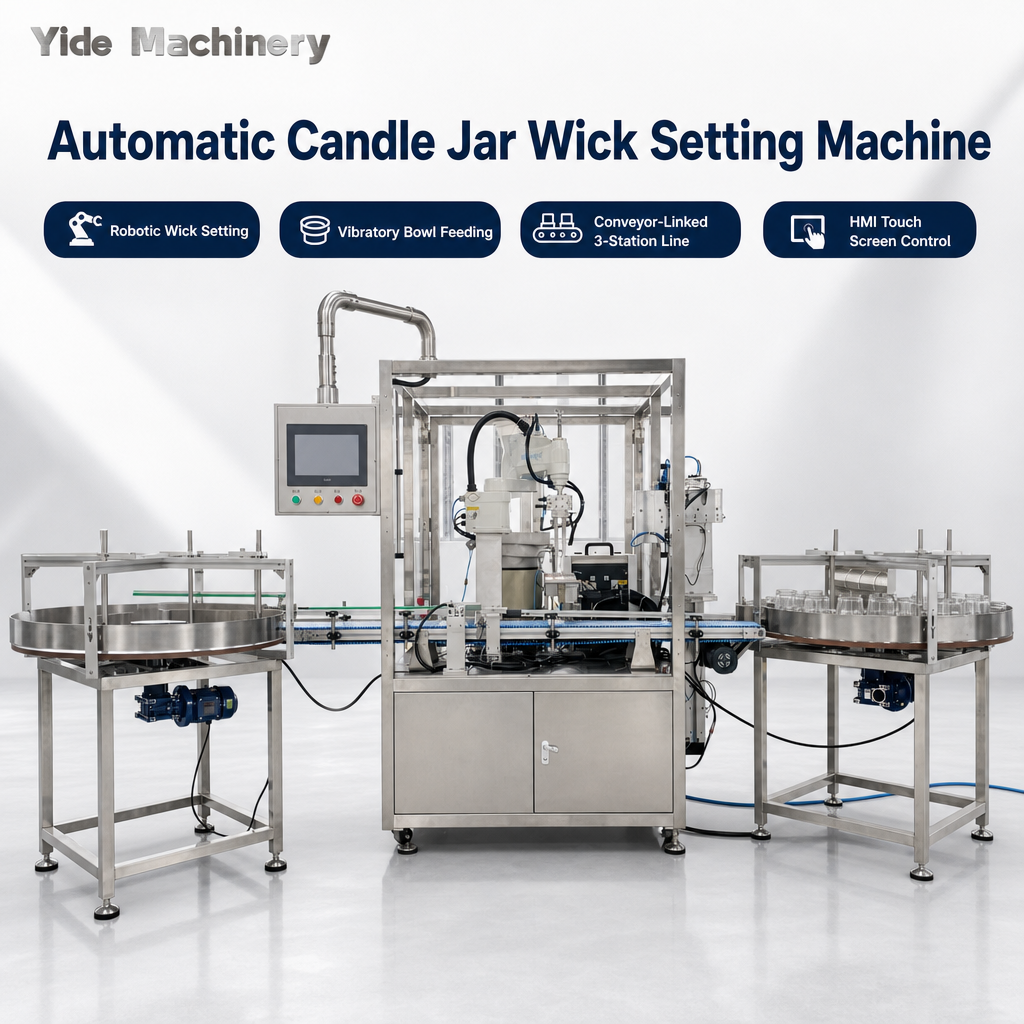
A wood-wick candle production process needs more than a wick placed inside a jar. The wooden wick must fit its holder, adhesive must be applied to the holder base, and the assembly must be placed in the intended position inside the container.
An automatic wood wick inserting machine brings these operations into a coordinated process. For a candle manufacturer evaluating automation, the important question is not simply whether a machine can insert a wick. It is whether the proposed configuration can handle the actual wooden wicks, metal holders, containers, and adhesive used in production.
The YD-QZD-II product sheet provides a starting point for that evaluation. Below, we explain its described workflow, the listed specifications, and the questions to resolve before ordering.
What Does an Automatic Wood Wick Inserting Machine Do?
The supplied product introduction describes a machine that assembles a wooden wick with a wick holder, applies glue to the bottom of the holder, and uses a robotic arm to place the assembly into a jar. It also describes a complete set that includes a sorting table and a glue-melting machine.
Wooden wick and holder assembly
The first operation combines the wooden wick with its holder. Compatibility should be assessed using the buyer's actual components rather than appearance alone. Ask the equipment supplier to evaluate the wick dimensions, holder geometry, and consistency between component batches.
Adhesive application
The next operation applies adhesive to the bottom of the holder. The product introduction describes this as spraying glue. The actual applicator design, adhesive specification, and adjustable process settings should be confirmed for the supplied configuration.
Placement inside the jar
A robotic arm places the wick assembly into the container. Before selecting the machine, define the required placement position and acceptable variation, then ask the supplier to demonstrate the result using representative containers.
YD-QZD-II Specifications at a Glance
The following values are transcribed from the supplied product sheet. They are not an independent performance test.
Model: YD-QZD-II
Power supply: 220 V, 50 Hz, single-phase / 380 V, 60 Hz, three-phase
Power: 8.4 kW
Driving mode: Pneumatic + electric
Wick-gluing quantity: Single wick
Container height range: 30–180 mm
Machine dimensions: 2100 × 2110 × 1900 mm
Weight: 608 kg
Iron-holder dimensions listed: 16 mm, 13 mm, 11.5 mm
Confirm which electrical configuration will be supplied for your facility. The two power-supply entries should not be interpreted as proof that every machine can switch between them.
The holder entries also need clarification: the sheet does not establish whether these values are separate holder sizes or different dimensions of one holder. Request a drawing or sample confirmation rather than treating them as a complete compatibility specification.
Does the Machine Support Single or Multiple Wicks?
This is an important point to clarify before purchase. The product introduction refers to single- and multi-wick insertion, while the technical table lists a single-wick configuration.
For selection purposes, treat single-wick operation as the listed specification. If a container needs multiple wick assemblies, ask the supplier to confirm the required configuration, positioning pattern, tooling, and demonstrated output. Do not assume that multi-wick capability is included as standard.
What Should You Check Before Choosing the Machine?
Check the complete container geometry
The listed container height range is 30–180 mm. Height alone, however, is not enough to establish compatibility. Provide container drawings or samples so the supplier can assess the opening, internal shape, base, and access for placement. The supplied sheet does not specify a container-diameter range.
Test the actual wick, holder, and adhesive combination
Request a sample trial using production-intent materials. Assess the assembled wick, holder seating, adhesive application, and final position in the jar. Agree on the evaluation method before comparing trial results.
Confirm utilities and installation scope
The machine uses pneumatic and electric drive, but the sheet does not state the required air pressure or air consumption. Obtain these requirements along with electrical installation details, maintenance-access needs, and a layout drawing. Confirm whether the listed dimensions cover the complete installed set or only the main machine.
Ask for output under defined conditions
The product sheet does not provide production capacity or positioning accuracy. Request demonstrated output for your specific container, wick, holder, adhesive, and wick count. Distinguish stable running output from results that include loading, stoppages, rejected parts, and changeovers.
When Is Automation Worth Evaluating?
Consider this type of machine when wick assembly, adhesive application, and placement are operations you want to coordinate more closely. Its suitability should be judged against your current process rather than a generic promise of faster production.
Compare manual handling, accepted output, reject causes, changeover effort, and operating requirements during a trial. The product description explains the intended functions; it does not establish a particular labor saving or return on investment.
Frequently Asked Questions
What container heights are listed for the YD-QZD-II?
The supplied sheet lists a container height range of 30–180 mm. Other container dimensions and the placement requirements still need sample-based confirmation.
Is multi-wick insertion included as standard?
It is not confirmed by the supplied information. The introduction mentions multi-wick insertion, but the technical table specifies single-wick operation. Confirm any multi-wick requirement before ordering.
Does the described set include glue-melting equipment?
The introduction describes a complete set that includes a sorting table and a glue-melting machine. Confirm the precise supply scope in the quotation and order documents.
Can the machine be customized?
The product introduction states that standard and customized versions are available. The feasibility and scope of any particular modification must be confirmed with the supplier.
Start with Your Production Samples
Prepare your container drawings or samples, wooden wick dimensions, holder specifications, adhesive requirements, target wick count, and available utilities. Use these inputs to request a configuration proposal and a sample trial. This gives equipment selection a clearer basis than choosing from a specification table alone.