
 EN
EN
 AR
AR
 BG
BG
 HR
HR
 DA
DA
 NL
NL
 FI
FI
 FR
FR
 DE
DE
 EL
EL
 HI
HI
 IT
IT
 JA
JA
 KO
KO
 NO
NO
 PL
PL
 PT
PT
 RO
RO
 RU
RU
 ES
ES
 SV
SV
 TL
TL
 IW
IW
 ID
ID
 LV
LV
 SK
SK
 SL
SL
 VI
VI
 ET
ET
 HU
HU
 TH
TH
 TR
TR
 AF
AF
 LB
LB

Why wick inserting decides your yield
A tea light is a simple object: an aluminum cup, wax, and a cotton wick. That unremarkable little wick is the hardest part of the whole line to get consistently right.
The reason is that wick inserting is a one-way operation. Once the wick is anchored to the base of the cup, a wick that sits off-center, leans, or is loosely fixed produces a rejected unit no matter how accurate the filling and cooling stages are. Rework also means scrapping the cup and the wax together, so the loss stacks up directly on your cost.
Put differently: wick inserting is the station that decides whether units live or die. It is worth spending real time on the selection decision.
Three approaches compared
| Manual insertion | Semi-automatic machine | Rotary automatic wick inserter | |
|---|---|---|---|
| Placement consistency | Depends on operator feel; varies between batches | Clearly better, but still needs manual loading | Set by mechanism and program; consistent within a batch |
| Labor | High — output growth requires more people | Moderate — operators load and unload | Low — mainly loading, inspection and changeover |
| Rhythm stability | Affected by fatigue and skill | Good, but paced by the operator | Stable; runs continuously |
| Changeover | None needed, but slow overall | Average | Design-dependent; changeover speed is the key spec |
| Best fit | Very small batches, sampling, multi-variety trials | Small-to-mid batches, budget-limited interim solution | High-volume, stable production of an established product |
The conclusion is blunt. If your tea light product is finalized and you need stable volume production, a rotary automatic machine is the only approach that holds consistency. Semi-automatic equipment is a reasonable interim step. Manual insertion belongs in sampling only.
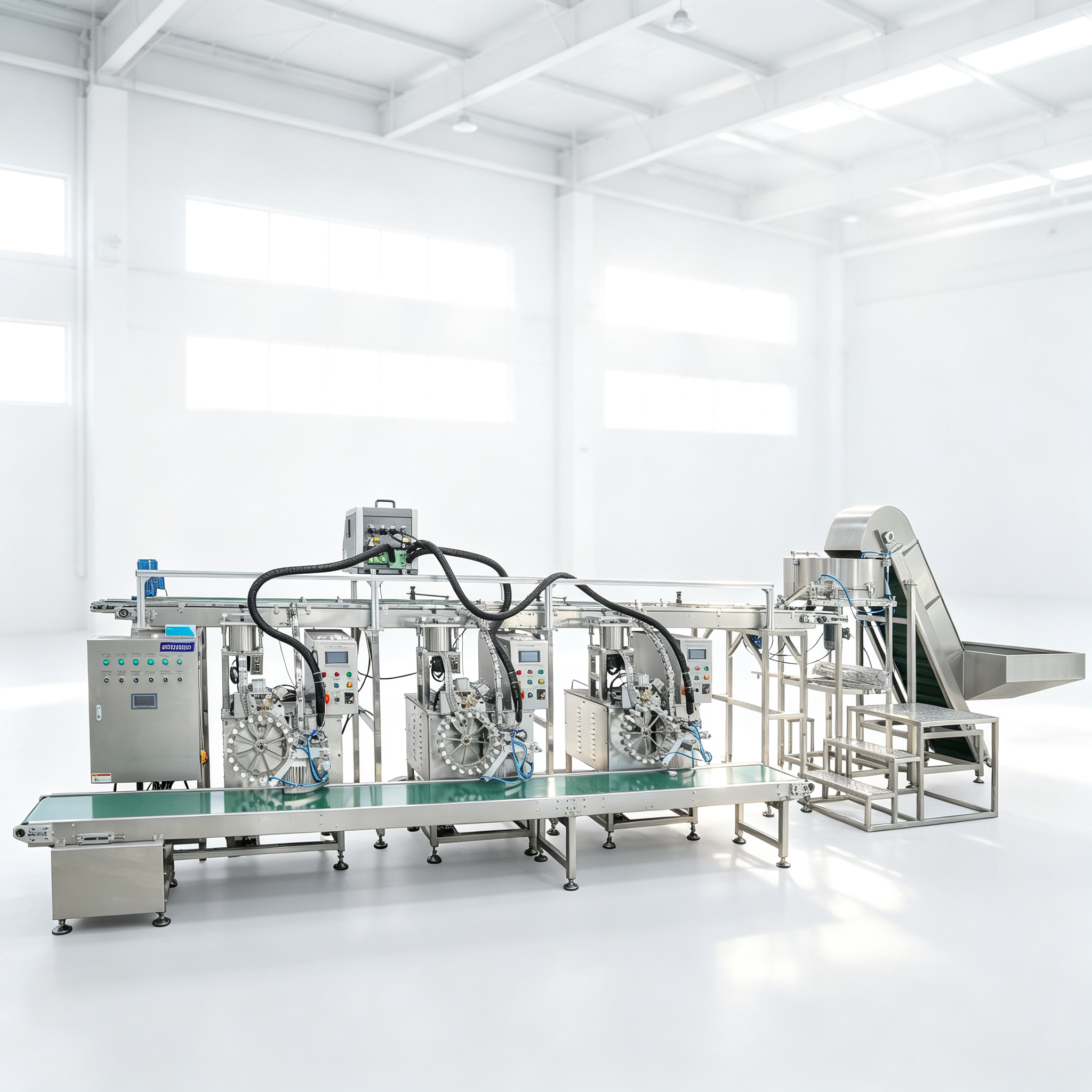
How a rotary tea light wick inserter works
The rotary layout is the mainstream form factor for this equipment. The logic breaks into three steps:
- Indexing — the rotary table advances cups to the insertion station on a fixed rhythm, so every cup receives the action at the same position.
- Insertion — the mechanism feeds the wick to a set length into the base of the cup, positioning and anchoring it.
- Continuous cycling — the whole sequence runs under PLC control and links to the conveyor for continuous operation.
The practical benefit of PLC-controlled automatic insertion is repeatability. Once the program parameters are set, cup number one and cup number ten thousand are inserted to the same standard. That is what replaces the operator's hand.
Five things to check when you buy
1. Range of wick diameters and cup types
What wick diameters and cup types do you actually run? Can one machine cover them? Always test with your own cups and your own wicks — not with the samples on the catalog page.
2. Placement consistency
This is the core spec. The test is simple: run a continuous batch, then sample and measure wick off-center deviation and verticality. Look at the spread within the batch, not at the single best unit.
3. Changeover time
If you run multiple specifications, changeover speed decides whether you can take small orders at all. Ask specifically: which parts have to be changed for a new cup size? Are tools required? How long does it take a normal operator to learn?
4. Whether it can link to filling
Wick inserting is only the upstream stage. Whether the machine can align on rhythm with downstream filling and conveying determines whether it is a standalone unit or one station of a line. A machine that is perfectly fine on its own but mismatched in rhythm is the most common reason a line never reaches rated output.
5. Maintenance and spare parts
The inserting mechanism is a high-cycle moving assembly. Wear-part replacement intervals, commonality of spares, and supplier response time are the difference between a machine that lasts three years and one that lasts ten.
Four common problems and where to look
| Symptom | Likely cause | Where to check |
|---|---|---|
| Off-center wicks | Play in the locating mechanism; cups not seated accurately | Check indexing and cup-conveyor repeat accuracy |
| Wicks floating up | Anchoring step failing; poor wick-to-cup-base fit | Check insertion force / anchoring method and cup base material |
| Wicks leaning | Drift in the wick feed path; worn mechanism | Check the wick feed guide and wear parts |
| Throughput below expectation | Loading cannot keep up; rhythm mismatched with downstream | Calculate line rhythm end to end and find the slowest station |
Nearly all wick inserting problems trace back to one of two roots: inaccurate locating or insecure anchoring. Approach a site visit with that framework and diagnosis gets much faster.
Wick inserting equipment from Yide Machinery
Dongguan Yide Machinery Equipment Co., Ltd. was established in 2008 and has long been engaged in the research, development, production and servicing of packaging machinery and automated candle-making equipment. The company's rotary tea light wick inserting machine uses PLC control for automatic wick placement and is built for continuous production of established products such as tea lights. Its companion adjustable-length cotton wick cutting machine lets the same line serve cups of different heights.
Because the company also supplies wax melting and holding equipment, filling machines, and labeling and coding equipment, the wick inserter is easier to align with upstream and downstream stations — in rhythm and in spare parts standards.